

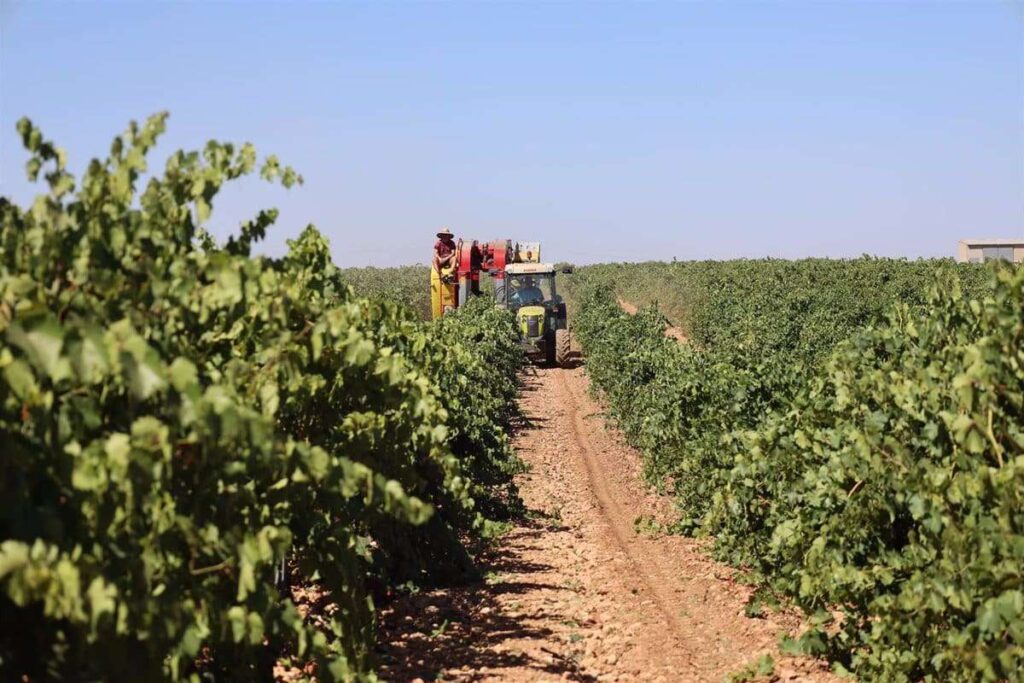
The La Mancha Denomination of Origin, known worldwide for its extensive area—the famous “Great Vineyard of Europe”—is not exempt from the adjustments currently affecting the Spanish wine sector. The latest statistics from the Regulatory Council indicate that the area of registered vineyards decreased in 2025, confirming a downward trend observed over the past decade. However, the DO remains a significant production engine with notable varietal diversity.
Specifically, the registered area decreased from 146,859 hectares in 2024 to 144,709 hectares in 2025, representing a -1.47% year-on-year reduction. While the decline is moderate in percentage terms, it is significant in what it represents: even in the largest denomination of origin by area in the country, the vineyard is adjusting in response to changes in profitability, farm structures, and market evolution.
A Trend Within the National Context
The evolution in La Mancha is better understood when looking at the bigger picture. According to a report from the Ministry of Agriculture, Fisheries and Food (MAPA), the “potential wine production area in Spain” as of July 31, 2025 was 929,472 hectares. This same document notes an accumulated decrease since the 2011/12 season, quantified as 122,694 hectares less, illustrating the scale of transformation throughout the country.
In Castilla-La Mancha, viticulture remains an economic pillar: the community holds 428,778 hectares, accounting for 47.4% of the national total, maintaining its status as the largest vineyard in Spain. However, this regional strength coexists with an increasingly evident reality: the sector is being restructured, and part of the traditional vineyard is losing weight against new cultivation, investment, and diversification strategies.
Fewer Hectares, But Vineyards Remain Key
Among the reasons discussed to explain the decrease in DO La Mancha are several familiar factors in the Manchego field: lack of profitability in smaller farms and diversification towards other crops—such as olive, pistachio, or almond. This trend affects not only the snapshot of each season but also the structure of the agricultural territory and the distribution of added value in rural areas.
Nevertheless, the vineyard remains a strategic crop in the region. Not only due to production volume but because it supports an agri-food industry with wine as the protagonist, directly impacting cooperatives, wineries, seasonal employment, and logistical activity. Locally, this dynamic is particularly strong in the province of Ciudad Real, which continues to have the largest productive capacity within the DO.
Provinces: Ciudad Real Leads in Area But Sees a Greater Decline
Of the total 144,708 hectares included in the La Mancha Denomination of Origin, the provincial distribution shows clear leadership:
- Ciudad Real: 68,693 ha, with a decline of -2.69%.
- Cuenca: 30,730 ha.
- Toledo: 25,859 ha.
- Albacete: 19,425 ha, being the only province with a slight increase (0.62%).
At the municipal level, Villarrobledo (Albacete) stands out with 14,620 ha, noted as the term with the largest area of registered vineyard in the DO. Among the major wine municipalities in Ciudad Real are Socuéllamos (12,198 ha), Alcázar de San Juan (8,765 ha), Tomelloso (7,816 ha), and Campo de Criptana (6,641 ha). In Cuenca, the reference is Mota del Cuervo (5,083 ha), and in Toledo, Villanueva de Alcardete (4,292 ha) tops the provincial list.
For the province of Ciudad Real—and by extension for towns in Ciudad Real’s La Mancha—the provincial figure is particularly relevant: the vineyard continues to lead in volume, but it is also where the decline is most noticeable in proportional terms.
Varieties: Many Whites Grow, and Only One Red Sees Clear Increase
Beyond the total area, the varietal map of the DO La Mancha presents an interesting perspective: the denomination reflects a diversification and an adaptation towards demand profiles where white varieties are gaining prominence.
In whites, Airén remains dominant with 79,235 ha, although it has seen a decrease of -3.1%. Verdejo has also decreased to 3,326 ha (-2.18%). In contrast, other white varieties have increased:
- Macabeo/Viura: 8,597 ha (+2.9%)
- Chardonnay: 2,879 ha (+8.6%)
- Sauvignon Blanc: 2,515 ha (+4.93%)
- Moscatel de grano menudo: 1,316 ha (+2.3%)
- Pedro Ximénez: 495 ha (+10.9%)
In reds, the behavior is more muted. Garnacha Tintorera is the only variety to stand out with an increase, now at 2,952 ha (+14%). Cencibel/Tempranillo remains the most prevalent with 28,307 ha, though it has slightly decreased (-1.2%). Other varieties have also declined: Garnacha tinta (3,296 ha, -2.8%), Syrah (3,255 ha, -2.3%), Cabernet Sauvignon (3,185 ha, -1.1%), and Merlot (1,458 ha, -2.8%).
The underlying trend points to a denomination that, despite the reduction in area, continues to rebalance its vineyard to meet market demands and consumption styles, reinforcing the presence of specific whites while retaining a broad red catalog.
Vinegrowers: Generational Change Again in Focus
Another key indicator of change is the number of registered vinegrowers. In 2025, there were 12,790, down from 12,899 registered in 2024. In terms of provincial activity, the highest numbers are concentrated in Ciudad Real (5,711 vinegrowers), followed by Cuenca (3,394), Toledo (2,580), and Albacete (1,871).
This evolution, although slight in annual terms, brings to the forefront an issue that the sector frequently addresses: generational change. Fewer vinegrowers and fewer hectares in certain areas may accelerate the concentration of farms and lead to a more professionalized viticulture, but they also raise questions about the maintenance of traditional agricultural structures.
Frequently Asked Questions
How many hectares of vineyard does DO La Mancha have in 2025 and how much has it decreased compared to 2024?
In 2025, there are 144,708 hectares registered, down from 146,859 in 2024, representing a decrease of -1.47%.
Which province has the most vineyard within DO La Mancha?
The province with the largest area is Ciudad Real, with 68,693 hectares, although it also registers a decline of -2.69%.
What white varieties are growing in DO La Mancha according to the data from 2025?
The increasing white varieties include Macabeo/Viura, Chardonnay, Sauvignon Blanc, Moscatel de grano menudo, and Pedro Ximénez.
How many vinegrowers were registered in DO La Mancha in 2025?
In 2025, 12,790 vinegrowers were registered, slightly below the 12,899 in 2024.
Spanish post in La DO La Mancha pierde superficie de viñedo en 2025, pero refuerza su liderazgo y apuesta por variedades blancas